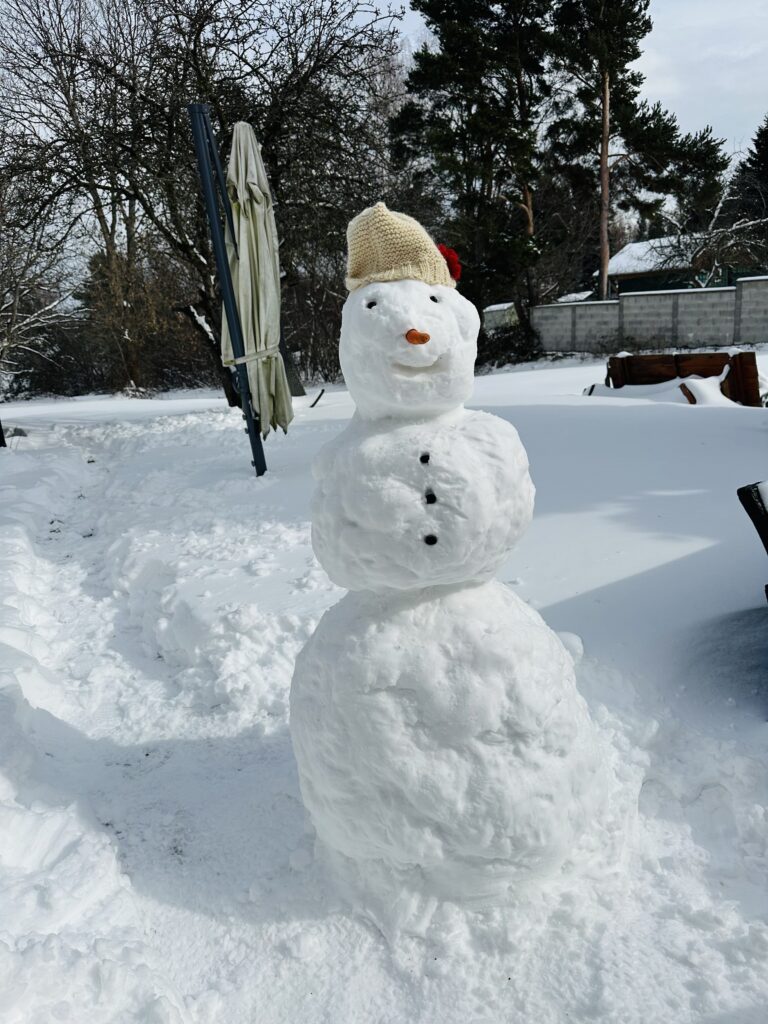
He was the first to step into the garden in the early hours of the morning. Snow had fallen quietly through the night, covering the world like a white secret. There were no footprints yet; the snow was an untouched page. With his gloved hands, he made the first snowball. He rolled it, enlarged it, pushed it forward. With every step, it grew heavier—taking shape little by little.
He didn’t realize it then, but he wasn’t only building a snowman. He was rolling his silence, his longing, and a quiet resentment toward someone—together with the snow.
After shaping the base, he placed the second layer on top. Then, carefully, he set the third and smallest piece in place. He stepped back and looked at it for a moment.
“It looks human,” he murmured to himself. As if it might start speaking any second.
He went inside and brought out a carrot. As he fixed it in place for the nose, he smiled without meaning to. From a drawer, he found some old buttons and lined them down the body. Finally, he retrieved a cream-colored beanie from the wardrobe—one he hadn’t worn in years, yet could never bring himself to throw away. He placed it on the snowman’s head. It was no longer just a pile of snow; it looked as though it had a story.
The trees behind it stood bare. Their branches stretched toward the sky like thin fingers—asking for something, though unsure of what. The garden was silent. In that silence, he looked at the snowman’s face. It wore a slightly crooked smile.
“How long will you last?” he whispered.
No answer came, of course. But the answer was already known. When the sun rose a little higher, warmed a little more, came a little closer… the melting would begin.
For a moment, he thought, I wish you would never melt.
Then he knew it was impossible. Nothing in life remains as it is—not seasons, not people, not emotions.
That afternoon, someone came into the garden. Someone he hadn’t seen in a long time. They both looked at the snowman first.
“It’s beautiful,” the visitor said.
“Temporary,” he replied.
They fell silent. The distance between them was as cold and white as the snow. Unspoken words, misunderstood sentences, unfinished goodbyes—they all stood there in that garden, in the shadow of the snowman.
“It will melt,” the visitor said.
“I know.”
“And still, you made it.”
He nodded slightly. “Some things are worth doing, even if they will melt.”
At that moment, they realized the snowman was standing exactly between them. With its three-tiered body, it seemed to say this: A person is layered. At the bottom, there is weight. In the middle, fragility. At the top, hope. If these three do not stay in balance, the first warmth is enough to make everything fall apart.
As evening approached, the sunlight softened. The surface of the snow began to glimmer faintly. A thin drop of water slid down from beneath the snowman’s nose.
They both watched.
No one said, “Don’t go.”
No one said, “Stay.”
But one reached out a hand. The other hesitated—then took it.
Perhaps the next day the snowman would be a little smaller. Perhaps the beanie would fall. Perhaps the buttons would sink into the snow. But that day, in that garden, something had not melted.
Sometimes relationships are like snowmen: built even while knowing they are temporary. Because the point is not for them to last forever, but to give meaning to a season.
The next morning, the sun rose again. The snowman had grown smaller. But two different sets of footprints now lay side by side in the garden.